
The Great Buddha Hall That Once Stood in Ueno
Ueno Park in Taito City, Tokyo, was once the site of a temple called Kanei-ji temple during the Edo period. A great Buddha also stood there. It is said that the first statue was made in 1631 (Kanei 8) from clay covered with plaster. However, this first great Buddha collapsed in an earthquake. Later, a new great Buddha made of bronze was created, and finally in 1698 (Genroku 11), a Buddha hall was built. This hall was destroyed by fire in 1841 (Tenpo 12), but it was rebuilt in 1843 (Tenpo 14). In the great earthquake of 1855 (Ansei 2), the head of the great Buddha fell, but it was soon repaired.
Around 1873 to 1875 (Meiji 6–8), when Ueno Park was being developed, the Buddha hall was removed. After that, the great Buddha stood outdoors without a building. Several old photographs from the Meiji period show the great Buddha exposed to the open air, and we can still see these images on the internet today.
In 1923 (Taisho 12), during the Great Kanto Earthquake, the head fell again. Later, during World War II, the body was delivered to the government under the Metal Acquisition Law, and only the face remained. It is not clear whether the great Buddha was repaired after the Great Kanto Earthquake. Perhaps because the head was already missing, only the body was taken. If the headless great Buddha stood in Ueno Park for about 20 years, it must have been a very sad sight.
Since it was first built in 1631 (Kanei 8), the great Buddha has suffered from earthquakes, fires, and war many times, and it has taken its present form through these hardships. Now that the body is gone, it cannot fall again in an earthquake. Because it will “never fall again,” it is known today as the “Passing Exam Great Buddha,” and many students visit to pray for success in their exams.
-
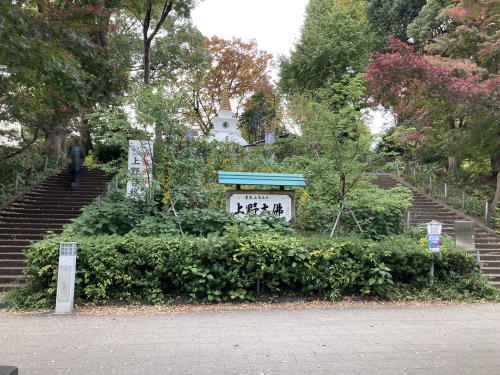
The face of the great Buddha and the hill with Yakushido Hall -
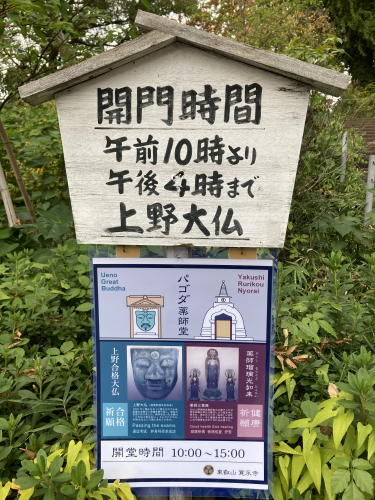
Guide sign for the Ueno Great Buddha and the Pagoda Yakushido Hall(As of December 2025)