
The Babasaki-mon Gate Ruins Are Now a Wide Road
I wondered whether nothing at all remains of Babasaki-mon Gate, so I tried to check books about it. I found a description saying that remains of the stone walls of Babasaki-mon Gate still exist. Is that really true?
When I went to see the place, there were indeed stone walls. However, the place where the gate once stood has now become a very wide road, and it does not seem that the original stone walls of the gate remain as they were.
Old photographs show that there used to be a wooden bridge at the gate. Today there is a wide roadway and sidewalk, and there is even a subway entrance at the corner of the sidewalk. A nearby intersection is called “Babasaki-mon.” Even if we look around carefully, we cannot see any gate at all. Some people may wonder why the intersection has such a name. It is simply because Babasaki-mon Gate once stood here.
-

The present situation of the Babasaki-mon Gate Ruins
Babasaki-bori Moat and Stone Walls
The area around the former Babasaki-mon Gate has been developed as Kokyo Gaien National Garden, a spacious park. On the north side of the gate ruins, Babasaki-bori Moat and stone walls remain. The stone walls facing the moat have gaps and give a rough, uneven impression. I can guess that this part has remained from the Edo period. On the other hand, the stone walls next to the sidewalk are made of larger stones that are neatly fitted together without gaps. Their surfaces are also smooth. I noticed that the impression of the stone walls differs depending on the location.
If I look at the area where the stone wall facing the moat meets the stone wall along the sidewalk, it feels a little unnatural. From nearby, it looks as if something was added later. When the present wide road was built, part of the stone wall must have been removed because it was in the way. That would have left the wall cut off. Perhaps clean stones were then brought here and placed as corner stones. These neat stones at the edge might once have been used in Babasaki-mon Gate. Maybe someone wanted to preserve them in some way and moved them here. That is one possible guess.
-
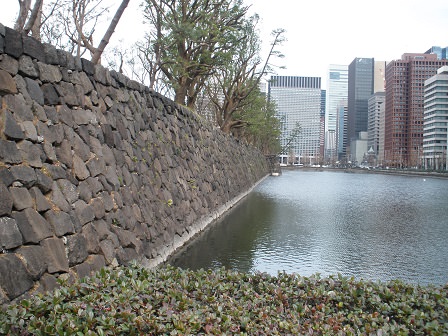
Stone wall facing Babasaki-bori Moat -
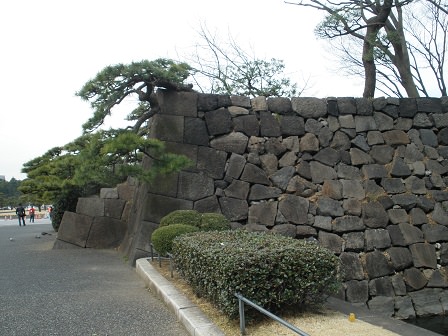
The neat stone wall along the sidewalk looks unnatural at the joint -
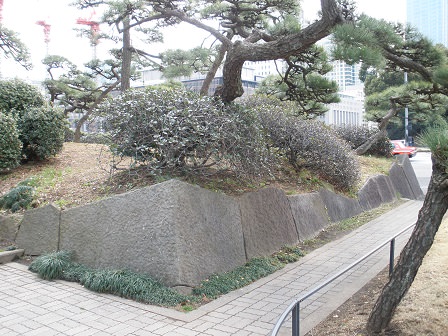
Stone wall on the Babasaki-bori Moat side -
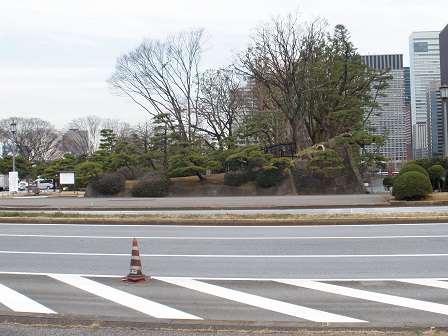
Stone wall on the Babasaki-bori Moat side seen from the Hibiya-bori Moat side
Cherry blossom viewing spots in Spring
Behind the stone wall on the Babasaki-bori Moat side is usually a quiet place with few people. The area is very large, so it may simply feel less crowded. Many benches are placed here. We can see people eating lunch or relaxing there.
Many cherry trees are planted behind the stone wall. When the blossoms open in spring, the number of visitors increases. These may be double-flowered cherry blossoms. The flowers look large and impressive. They are truly beautiful, so if it is possible to visit in spring, I strongly recommend coming here. If we travel by train, it is only a few minutes on foot from Nijubashi-mae (Marunouchi) Station on the subway. It is also within walking distance from JR Tokyo Station.
-
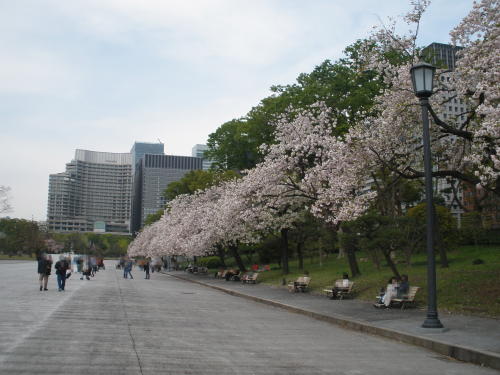
Cherry blossoms in full bloom in spring -

Cherry blossoms in full bloom, viewed up close
Hibiya-bori Moat and Stone Walls
On the south side of the gate ruins, Hibiya-bori Moat and stone walls also remain. As on the Babasaki-bori Moat side, the part facing the moat has gaps and looks rough and uneven. The part along the sidewalk is made of larger stones fitted closely together, and the surface is smooth. We can guess that part of the stone wall was removed and that neat stones were added where the wall was cut off.
-
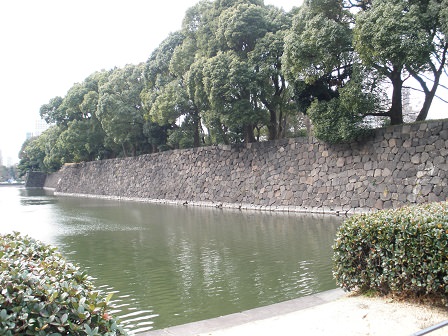
Stone wall facing Hibiya-bori Moat -
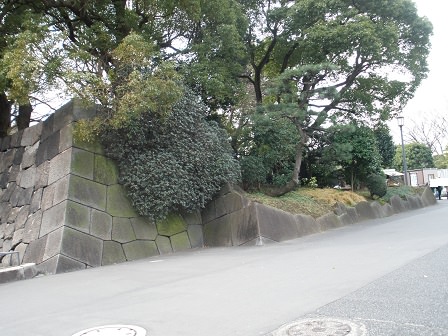
Neat stone wall along the sidewalk -
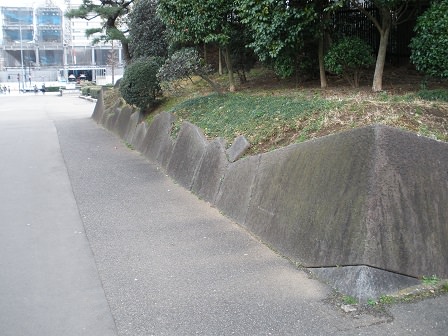
Another neat stone wall along the sidewalk -
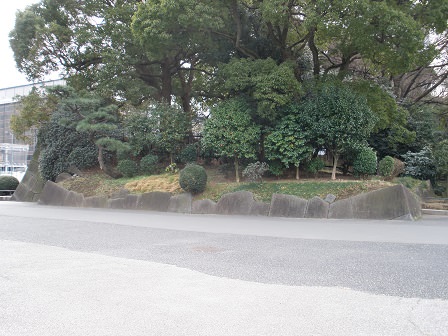
Stone wall on the Hibiya-bori Moat side seen from the Babasaki-bori Moat side
The Statue of Kusunoki Masashige, Nanko Rest House, and Kusunoki Sabou
Behind the stone wall on the Hibiya-bori Moat side there are several attractions. These include the statue of Kusunoki Masashige, Nanko Rest House, and a small shop called Kusunoki Sabou. There is also a large parking area for tour buses. Many buses can park there. We often notice many groups of foreign visitors. At certain times of the year, there are also many Japanese school groups on school trips.
When they get off the bus, they usually go first to the statue of Kusunoki Masashige. After listening to an explanation, they take a group photo in front of the statue. Then they slowly walk together toward the Imperial Palace. I have never followed a group, but they probably go as far as the Imperial Palace Main Gate. We are not sure whether they take another group photo there, but before long they come back.
If there is time, many people buy something to eat at the shop called “Kusunoki Sabou” in front of the statue. This shop sells food and drinks. Many people seem to buy soft-serve ice cream. There are many benches near the shop, so people sit there and enjoy what they bought. When it is time, they return to the bus.
When I rest on the benches around the statue and watch the visitors, this is usually what I see. It is fun to hear many different languages from around the world.
Several cherry trees are also planted on this side. Compared with the Babasaki-bori Moat side, the number is much smaller. Even so, when the blossoms open in spring, they are very beautiful.
-
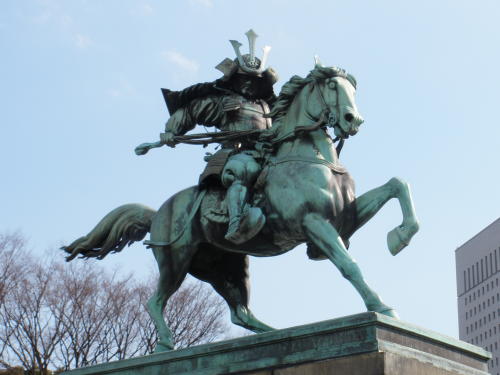
Statue of Kusunoki Masashige near the Babasaki-mon Gate Ruins -
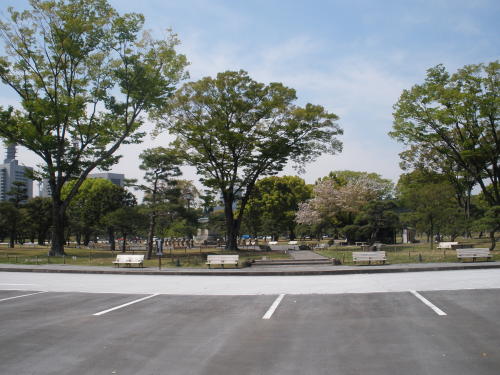
The area around the statue -
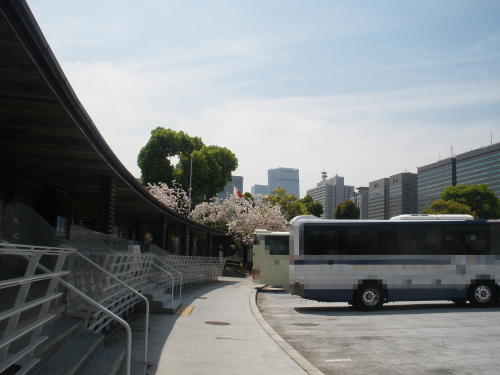
Tour buses lined up in the parking lot in front of Nanko Rest House -
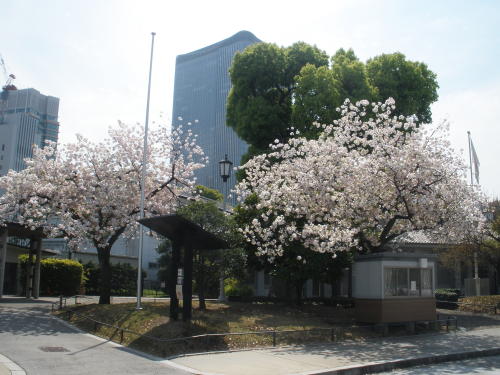
Cherry blossoms beside Nanko Rest House -
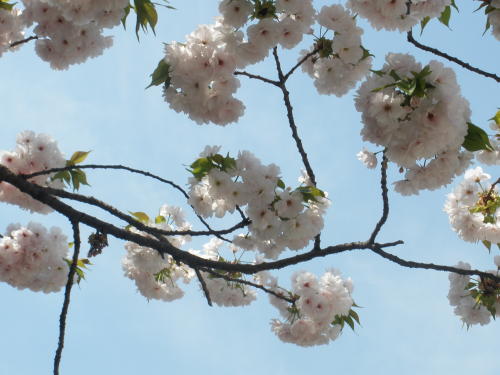
Cherry blossoms seen up close -

“Kusunoki Sabou,” which opened in April 2023