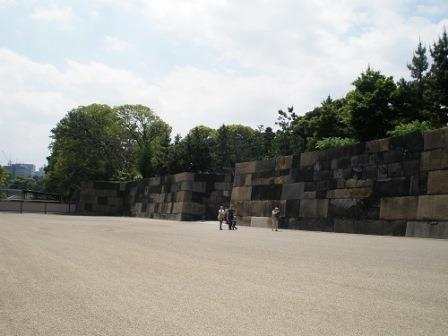
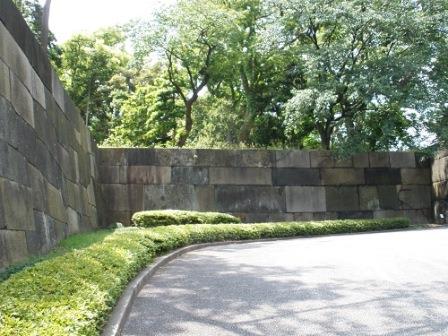
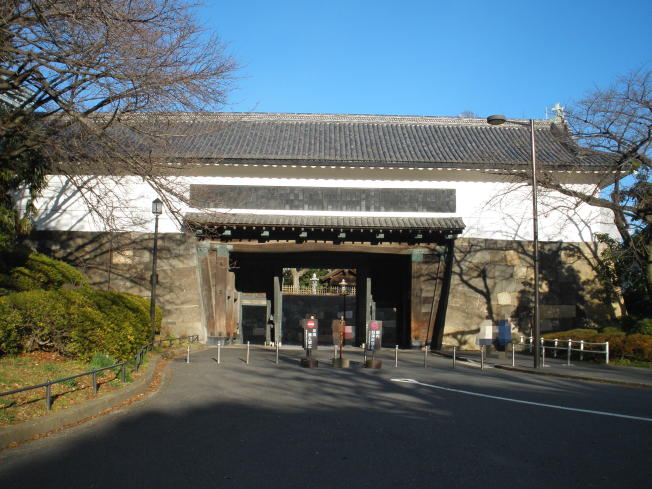
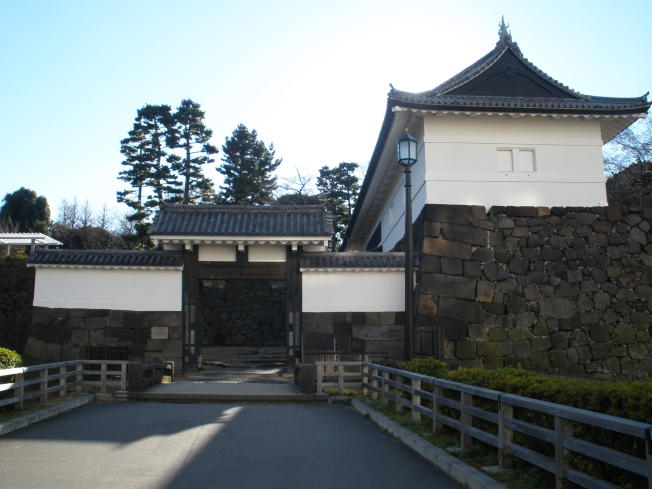
Naka-no-mon Gate and the Hyakunin-bansho Guardhouse The remains of Naka-no-mon Gate feature massive stone walls and are open to the public inside the East Gardens of the Imperial Palace. In front of these huge stone walls stands the long, narrow Hyakunin-bansho, and inside the gate there is the Obansho guardhouse. Chiyoda Ward: Inside of East Gardens of the Imperial Palace
Chujaku-mon Gate and Shin-mon Gate Ruins The stone walls of the Chujaku-mon Gate that remain in the East Gardens of the Imperial Palace. Beyond this gate lay the Honmaru (main enclosure). The gate was destroyed by a major fire in 1863 (Bunkyū 3), and parts of the stone walls were burned, giving them a darker color and an uneven surface. Chiyoda Ward: Inside of East Gardens of the Imperial Palace
Ruins of Main enclosure It is part of the East Gardens of the Imperial Palace, featuring a vast lawn and many flowers, making it a place where people can relax. Chiyoda Ward: Inside of East Gardens of the Imperial Palace
Kita-hanebashi-mon Gate It is currently used as one of the three entrances to the East Gardens of the Imperial Palace. One of the features of the gate was a mechanism to raise the wooden bridge on the outer gate side. Chiyoda Ward: Inside of East Gardens of the Imperial Palace
Kuichigai-mon Gate of the Second enclosure Chiyoda Ward: Inside of East Gardens of the Imperial Palace
Hanzo-mon Gate Currently serving as one of the entrances to the Imperial Palace, it has become a gate for mere observation from a distance. Chidori-ga-fuchi Park, facing the Hanzo Moat, is famous for its cherry blossoms in spring, and the Sakurada Moat is also worth seeing. Chiyoda Ward: Outer Garden of the Imperial Palace
Tayasu-mon Gate Inside Tayasu-mon Gate, there was once the residence of the Tayasu family. During the Great Kanto Earthquake, the inner gate was damaged, and it seems that it was not rebuilt at that time, leaving only the outer gate standing. The gate was also damaged during World War II, but today the inner gate has been restored. Chiyoda Ward: Inside of Kita-no-maru Park
Shimizu-mon Gate Inside Shimizu-mon Gate, there was once the residence of the Shimizu family. In the early Showa period, there appears to have been no inner gate. It was probably damaged in the Great Kanto Earthquake and was not rebuilt at that time. Today, the inner gate has been restored. Chiyoda Ward: Inside of Kita-no-maru Park
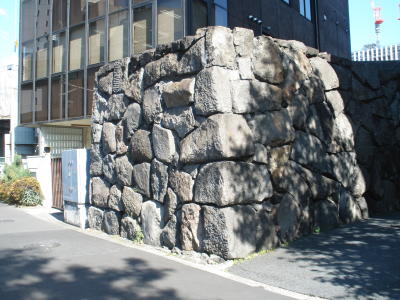
Kiji-bashi-mon Gate Ruins This gate was located between Takebashi Gate and Shimizu Gate. No traces of the gate can be found. Its relationship to Kijibashi Gate is unknown, but there is a mysterious building nearby that appears to be a reused stone wall from the Edo period, and has visible engravings. Chiyoda Ward: Near Takebashi Subway Station
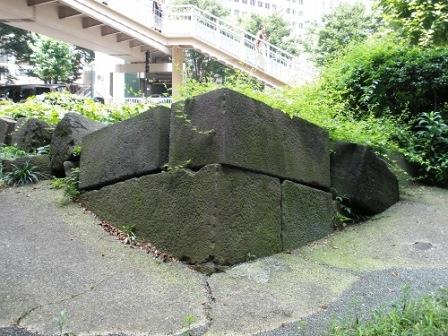
Hitotsu-bashi-mon Gate Ruins The site where Hitotsu-bashi-mon Gate once stood is now a wide roadway and a large building, but only a few remains of the gate can be seen near the current Hitotsu-bashi Bridge over the Nihon-bashi River. Chiyoda Ward: Near Takebashi Subway Station
Tora-no-mon Gate Ruins This area is now well known for places such as Toranomon Hills, but near the Tora-no-mon intersection once stood Tora-no-mon Gate, one of the gates of Edo Castle. Although no remains of the gate survive today and the moat has been filled in, several remnants of Edo Castle’s stone walls can still be seen nearby. Chiyoda Ward/Minato Ward: Close to Tora-no-mon Station
Yotsuya-mon Gate There is Yotsuya-mon Gate Ruin in front of JR Yotsuya Station, and the stone wall on the north side remain. Chiyoda Ward/Shinjuku Ward: Close to Yotuya Station
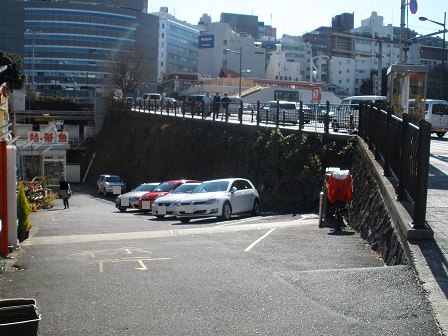
Ichigaya-mon Gate Ruins The Ichigaya-mon Gate of Edo Castle seems to have stood in the area in front of today’s JR Ichigaya Station. If you walk from the station and cross Ichigaya Bridge, you will find a fishing pond on the right-hand side. Around the parking area near its entrance, stone walls from the Edo period remain, and many engraved marks can still be seen on them. Chiyoda Ward/Shinjuku Ward: Close to Ichi-ga-ya Station