
Ichigaya-mon Gate Site
When you get off at JR Ichigaya Station and go out through the ticket gate, you will not find a typical station plaza. Instead, there is a wide road with many cars passing by. This area is the site of the former Ichigaya-mon Gate of Edo Castle. Even if you are told that, it may be hard to imagine, because there are no remaining gate structures or stone walls.
If you walk for one or two minutes from the station, you will reach Sotobori Park, a long and narrow park that follows the line of the former outer moat of Edo Castle. At the part of the park closest to JR Ichigaya Station, there is an information board about the Ichigaya-mon Gate site and several foundation stones that are thought to have come from the gate. These are about the only traces left of the gate. It is quite small, so it may be just right to take a look while visiting the area to see the cherry blossoms in spring.
-
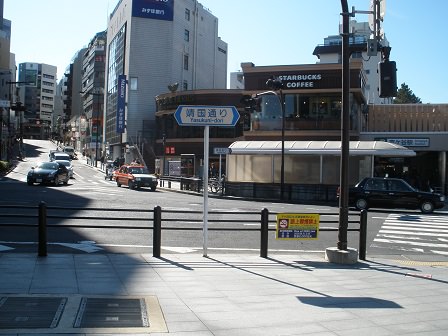
The current condition of the Ichigaya-mon Gate site -
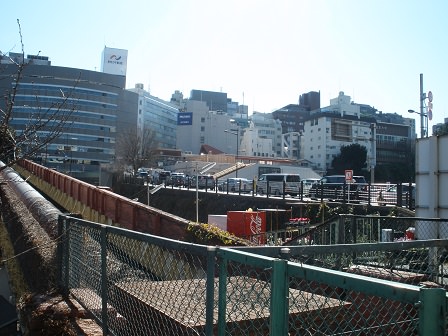
A distant view of the Ichigaya-mon Gate site (1) -
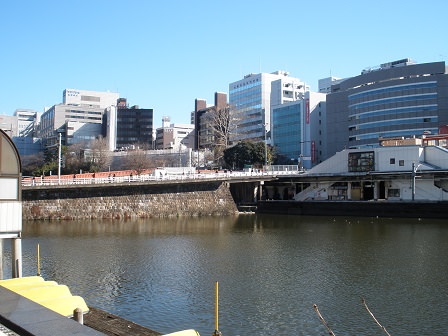
A distant view of the Ichigaya-mon Gate site (2)
Stone Walls and Engraved Marks of the Ichigaya Earthen Bridge
If you are thinking, “Is there anything more to see?”, walk a little away from the gate site, cross Ichigaya Bridge, and go to the other side of the outer moat.
After crossing the bridge, turn right and you will find the entrance to a fishing pond. As you go inside, you can see Ichigaya Bridge on your right, and below it you will notice stone walls. Not all of these stone walls, but many parts of them, are remains of the earthen bridge that once stood in front of the Ichigaya-mon Gate during the Edo period. If you look closely, you can see many engraved marks on the stones.
This area is currently used as a parking lot, so please be careful of cars when you visit.
-
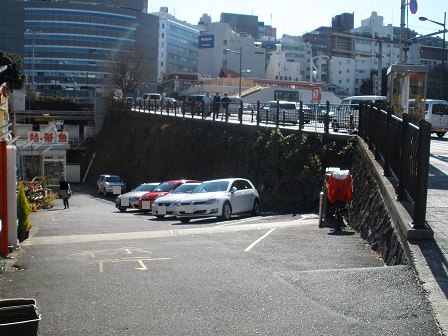
Stone walls of the Ichigaya earthen bridge and the entrance to the fishing pond -
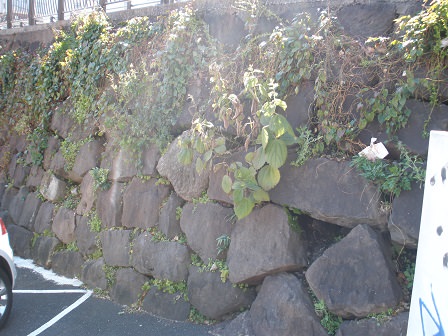
Stone walls of the Ichigaya earthen bridge (1) -
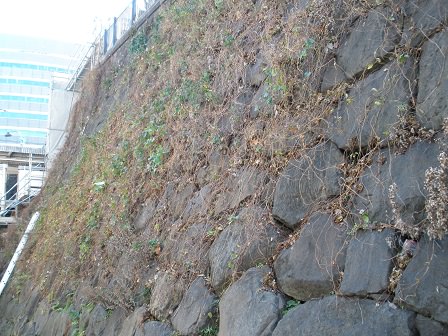
Stone walls of the Ichigaya earthen bridge (2) -

Engraved marks remaining on the stone walls of the earthen bridge (1) -

Engraved marks remaining on the stone walls of the earthen bridge (2) -
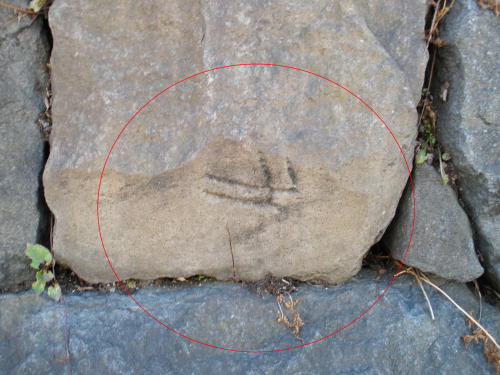
Engraved marks remaining on the stone walls of the earthen bridge (3) -
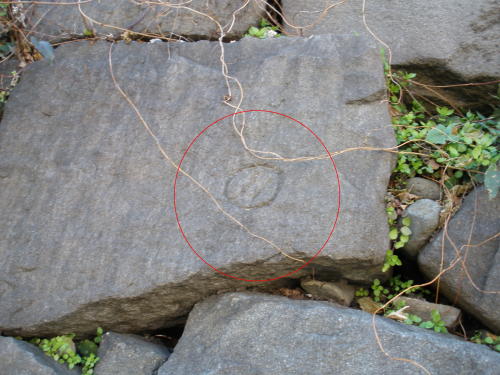
Engraved marks remaining on the stone walls of the earthen bridge (4) -
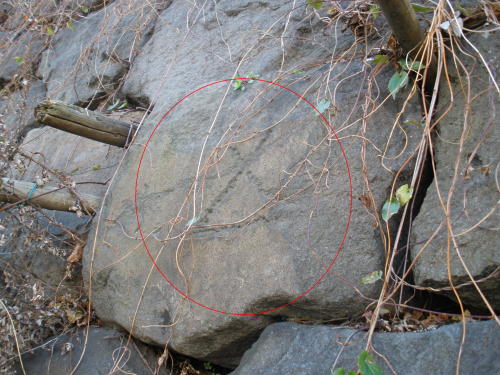
Engraved marks remaining on the stone walls of the earthen bridge (5)
Eboshii-shi (Eboshii Stone)
If you leave the gate site in front of JR Ichigaya Station and go to Hibiya Park in Minato City, Tokyo, you can see a very large stone that is said to have been used in the square enclosure of the Ichigaya-mon Gate.
For reasons that are not entirely clear, Hibiya Park contains many foundation stones that are thought to have come from Edo Castle. One easy-to-understand example can be found in parts of the stone pillars at the park entrances, where inscriptions in classical Chinese explain that stones reused from Edo Castle gates were used to make them. In addition, as you walk around the park, you will notice many stones lying around that appear to have once been part of stone walls from the Edo period.
The stone said to have belonged to the Ichigaya-mon Gate is not just lying somewhere in the park. It is properly displayed on the left-hand side after entering through the Saiwai-mon gate of the park. It is extremely large, so it would not have been possible to leave it lying around casually. Because of its shape, it seems to have been called the “Eboshii Stone,” and there is an explanation panel next to it.
-

Eboshii Stone in Hibiya Park (1) -

Eboshii Stone in Hibiya Park (2)