
Where Was Tora-no-mon Gate Located?
“Tora-no-mon” still lives on today as a place name and a station name in Tokyo, and many people may imagine an office district lined with skyscrapers. It is also known as the location of Toranomon Hills. However, it was originally one of the gates of Edo Castle. The gate seems to have been located near the Tora-no-mon intersection on Sotobori Street, slightly farther to the north. In terms of modern addresses, it was north of today’s Toranomon area, roughly where Kasumigaseki begins.
The bridge over the moat was an earthen bridge. After crossing the bridge and passing through the outer gate, one would enter the square enclosure, then turn 90 degrees to the left to reach the inner gate. In 1731 (Kyōhō 16), the gate was destroyed by a great fire. The outer gate, the Tobari guardhouse, and the walls of the square enclosure’s stone base were quickly reconstructed, but the inner gate was reportedly never rebuilt. Even in photographs taken in the early Meiji period, no structure believed to be the inner gate can be seen. Many of the gates of Edo Castle were dismantled during the Meiji period, but in the case of Tora-no-mon Gate, the stone base of the inner gate is said to have remained until 1934 (Shōwa 9). Today, however, even that has disappeared, and only the name Tora-no-mon remains as a place name and station name.
Because the moat around Tora-no-mon Gate has also been filled in, it is difficult to tell where what once stood. However, to the west of the former location of Tora-no-mon Gate, part of the stone wall remains that once lay between Tora-no-mon Gate and Tameike during the Edo period. This stonework was unearthed during reconstruction work at the Ministry of Education, Culture, Sports, Science and Technology and is now on display, making it possible to see it today.
Stone Base of the Southwesternmost Turret of the Outer Moat
When I went to photograph the remains, I was able to confirm four separate stone wall sites in total. Starting from the Tameike-Sannō Station side, I walked toward the site of Tora-no-mon Gate and viewed them in order.
Walking along Sotobori Street from JR Shimbashi Station toward Tameike-Sannō Station, just after passing the Tora-no-mon intersection, a sign reading “National Historic Site: Ruins of the Outer Moat of Edo Castle – Tameike Turret Base” comes into view on the left. This appears to be the location of the turret base stonework, but all that can be seen is a stone marker buried in thick greenery, with no obvious stone walls in sight. Thinking there must be something nearby, I went around to the back, and as expected, I found the remains of the stone wall. Only about the top two courses are visible, but the stones are neatly stacked with hardly any gaps. Looking at the side, some collapse can be seen, but these are clearly stones that were artificially shaped for a stone wall. The stones had taken on a slightly greenish color.
-
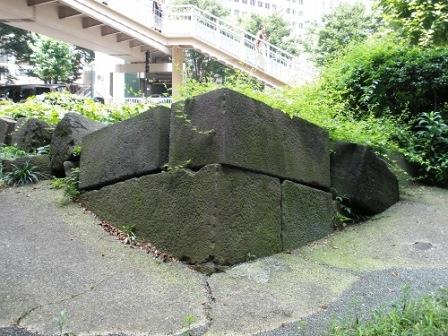
Corner stone of the Tameike turret base at the southwesternmost end of the outer moat -
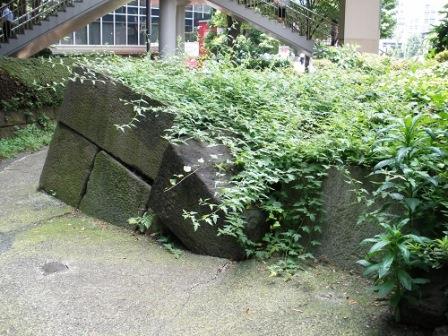
Side view of the Tameike turret base (2) -
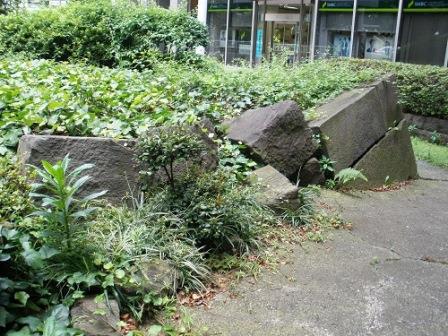
Side view of the Tameike turret base (3) -
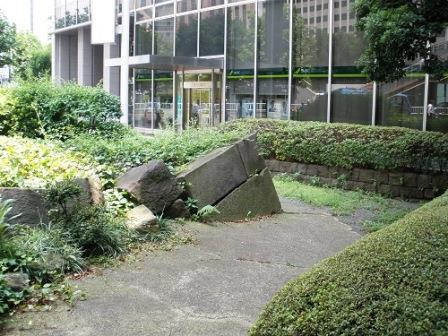
The Tameike turret base seen from a short distance away
Stone Wall in Front of the Former Education Hall
Next, I went to see the stone wall in front of the former Education Hall. Walking from the Tameike turret base toward the former location of Tora-no-mon Gate and crossing the traffic signal on Sotobori Street, something that looks like a stone wall comes into view. The stones show jagged traces of wedge holes, and because there are many gaps, smaller stones have been packed in between. Seeing it up close makes its roughness stand out even more. Existing stone walls of the outer and inner moats are usually viewed from a distance, which is probably why they tend to look fairly neat.
Plants have been placed on top of this stone wall, but this is clearly part of the exhibition design. Rather than removing the historic remains as obstructions, they have been skillfully preserved and displayed.
-
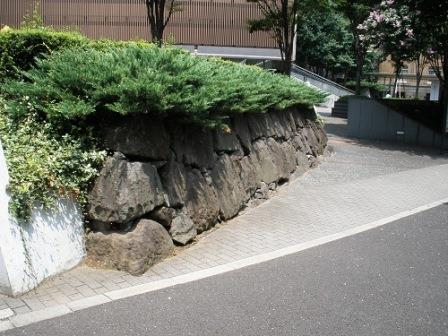
Overall view of the stone wall (1) -
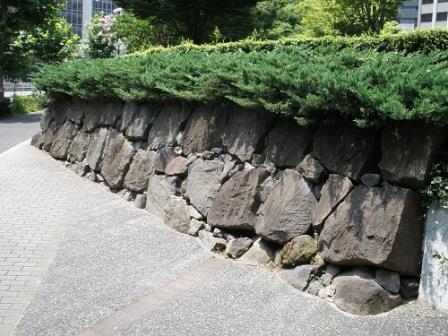
Overall view of the stone wall (2) -
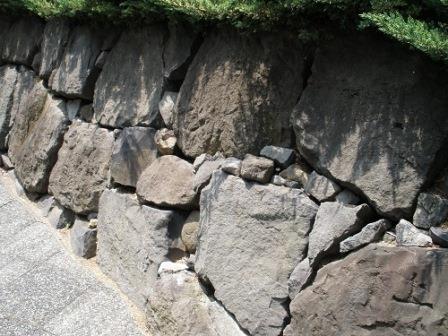
Close-up of the stone wall (1) -
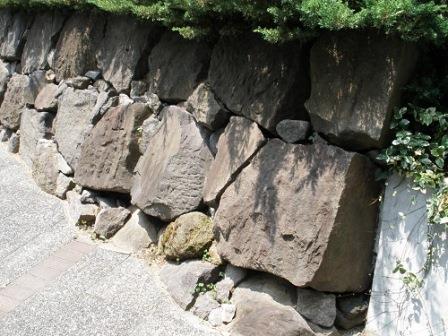
Close-up of the stone wall (2)
Yahazu-Shaped Stone Marks
Walking a little farther from the former Education Hall toward the site of Tora-no-mon Gate, another stone wall comes into view. It is located around Exit 11 of Toranomon Station on the subway. At first glance, it looks much the same as the previous stone wall, with a rugged appearance and stones packed into the gaps.
The most notable feature of this stone wall is the large number of stones carved with a yahazu (arrow-nock) shaped mark. This mark belongs to the Mori family of the Saeki Domain in Bungo Province, whose family crest is a circle enclosing a yahazu. Although the exact boundary is not clearly known, it is said that the area on the left was assigned to Mori Takanao of the Saeki Domain in Bungo Province, while the right side was assigned to Togawa Masayasu of the Niwase Domain in Bitchū Province. This is likely why stones with the yahazu mark are found here.
When people hear the name Mori, many may think of Motonari, famous for the tale of the “Three Arrows,” but Motonari’s lineage is the Mori family of the Chōshū (Yamaguchi) Domain in Suō Province, whose family crest is the “Nagato Three Stars.” The Mori family of the Saeki Domain, whose crest is the “Circle with Yahazu,” is different. In fact, the Saeki Mori family was of a separate lineage, and their original surname is said to have been Mori (written with a different character). Takamasa, the first head of the Saeki Mori family, was born in 1559 (Eiroku 2) and served Toyotomi Hideyoshi. In May 1581 (Tenshō 10), he joined Hideyoshi’s campaign against Takamatsu Castle in Bitchū Province, and during peace negotiations with Mori Terumoto, he and his younger brother Yoshiyasu were entrusted as hostages on the Mori side. Through this connection, he came to take the Mori surname. Takanao, who was in charge of this stone wall, was Takamasa’s grandson.
-
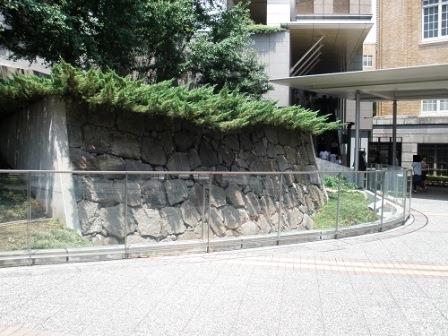
Overall view of the stone wall (1) -
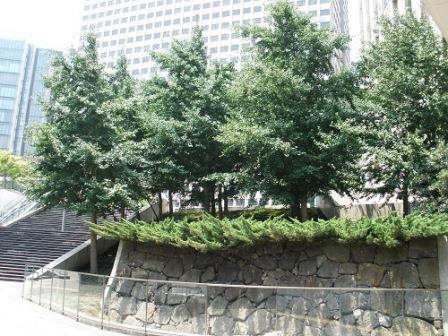
Overall view of the stone wall (2) -
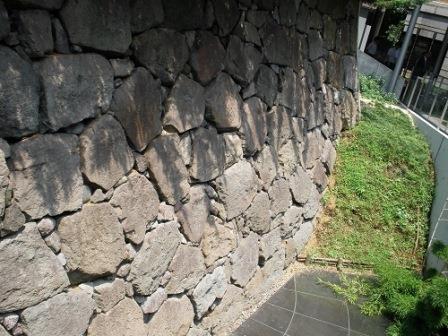
Close-up of the stone wall (1) -
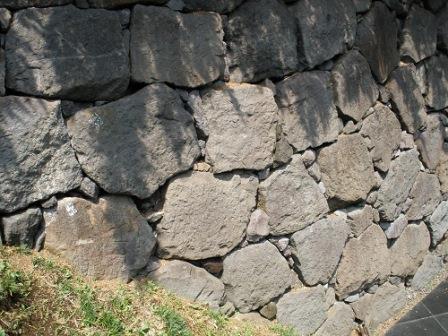
Close-up of the stone wall (2) -
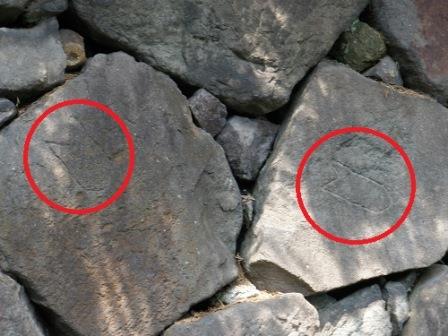
Stone mark of the Saeki Mori family carved into the wall (1) -
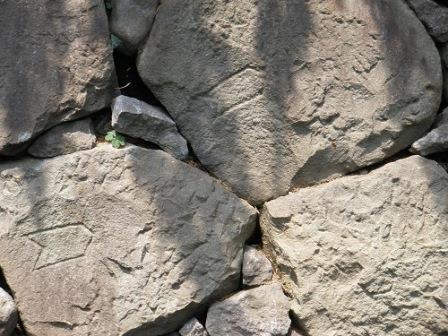
Stone mark of the Saeki Mori family carved into the wall (2) -
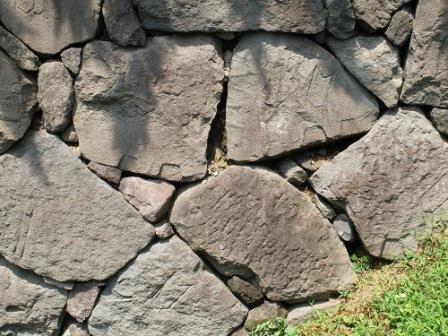
Stone mark of the Saeki Mori family carved into the wall (3)
Stone Wall in Front of the Lounge on the Ministry of Education Grounds
Walking farther from the stone wall near Exit 11 of Toranomon Station toward the former site of Tora-no-mon Gate, there is another stone wall in front of a lounge within the grounds of the Ministry of Education. Because this stone wall lies at a level lower than the surrounding ground, visitors can go down a set of steps to view it. On the wall in front of the stonework are panels explaining Edo Castle and its stone walls, including information about the construction of the outer moat stone walls in 1636 (Kan’ei 13) and the stone marks. Understanding this background makes viewing the remains even more interesting.
This stone wall is also built with many gaps, with smaller stones packed into them. Looking closely at the surfaces of the stones, faint linear patterns can be seen, though they are hard to make out. Perhaps they were finished with chiseling. Although deterioration and weathering have made them difficult to discern, they still appear to be traces of artificial processing. I also tried to look for stone marks, but while it seemed there might be some, I could not clearly identify any in the end.
-
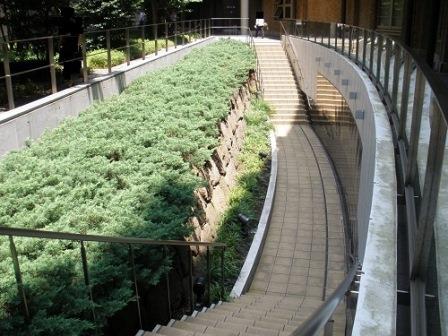
Overall view of the stone wall exhibition area seen from above -
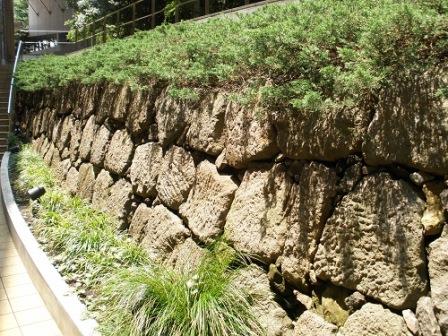
Overall view of the stone wall seen after going down the steps (1) -
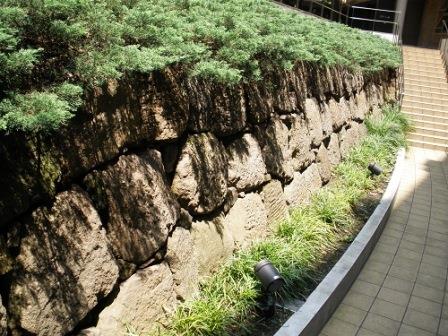
Overall view of the stone wall seen after going down the steps (2) -
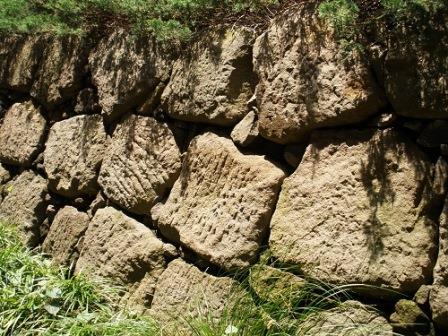
Somewhat close-up view of the stone wall -
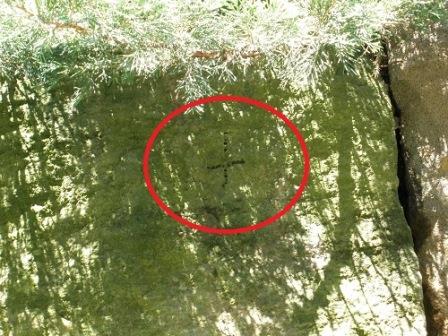
A stone mark? -
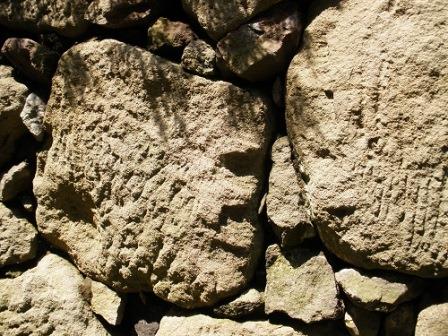
Close-up of the stone wall (1) -
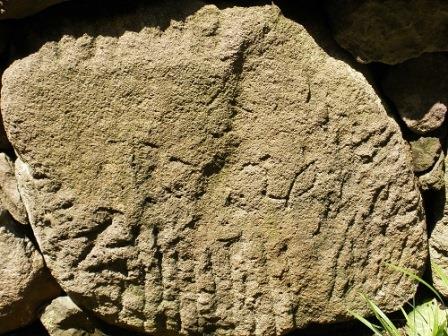
Close-up of the stone wall (2)